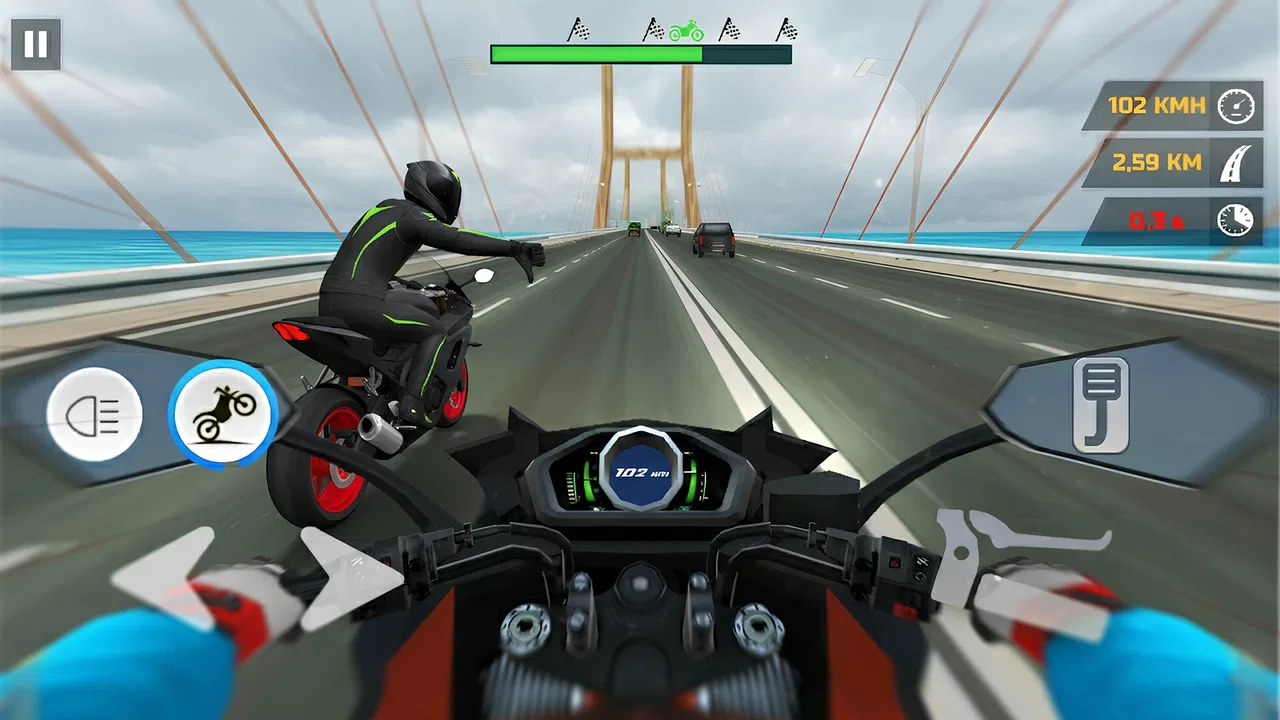
Wheelie Rider: Moto Racing
- 0.0
- Rating
- 500.00K
- Installs
- Free
- Price

 Analysis by App-foxy
I spent time with Wheelie Rider: Moto Racing as a quick, focused racing game built around one central challenge: keeping a motorcycle balanced while riding on its rear wheel. That sounds simple, but it changes the way I approached every run. Instead of merely steering toward the finish, I was constantly judging how long to hold the wheelie, when to settle the bike, and whether a risky stretch of speed was worth losing control.
That narrow focus is the game’s main appeal. It is not trying to replace a large motorcycle collection or a full racing simulator. Developer QUEEN CITY presents it as a free racing game for Android, and the experience feels designed for short sessions where the physical act of maintaining a wheelie is more important than managing a huge career. I found that refreshing when I wanted something immediate, although players looking for deep customization or a broad tournament structure may find the concept too concentrated.
Why the wheelie challenge changes the racing experience
The defining capability here is not simply riding quickly. It is controlling the motorcycle’s balance while speed and momentum are working against you. In a conventional racing game, I usually think about the racing line first: take the corner cleanly, avoid obstacles, and accelerate out. In this game, the first question becomes whether the front wheel should be down at all.
You May Also Like

 Pandora - Music & Podcasts
Pandora’s Music Is Easy to Start, but Harder to Recover
Pandora’s strength is its low-effort path from a seed to a station. Its weak spot is how much confidence it asks you to place in connection, setup, and quiet recovery.

 8 Ball Pool
 Is Built on Rivalries, Rematches, and Routine
A close look at the rivalries, rematches, shared routines, and unanswered safety questions that turn a quick pool match into a persistent mobile community.

 Samsung Music
’s Quiet Strength Is Playing What You Already Own
Its reach comes less from spectacle than from dependable access to a personal library. That simplicity is both the app’s strongest retention engine and its ceiling.

 AccuWeather: Weather Radar
AccuWeather Review: A Quick, Clear Forecast for Everyday Decisions
For everyday plans, the best forecast is the one you can understand quickly. AccuWeather makes rain timing, radar, and local conditions easy to act on, with a few trade-offs.

 Hill Climb Racing
Why Hill Climb Racing Still Turns Crashes Into One More Run
A tiny car, a bumpy hill and one more upgrade: Hill Climb Racing keeps resurfacing because its simple chaos makes every near-miss feel personal.

 AliExpress - Shopping App
AliExpress Makes Global Shopping Feel Personal, but Shoppers Bear the Risk
AliExpress turns a global marketplace into a pocket-sized discovery engine. Its reach is useful, its shopping loop compelling, and its trade-offs easy to miss.
More From Our News Desk
View All News


That creates a useful tension between confidence and restraint. Holding a wheelie can make a run feel exciting, but staying in that position for too long can turn a strong attempt into a crash. The result is a game loop that rewards small corrections rather than constant, dramatic movements. I quickly learned that pressing harder is not automatically better. A controlled adjustment at the right moment is more valuable than trying to force the bike into an impressive-looking pose.
The store summary describes a motorcycle racing simulator with smooth physics, and that emphasis is important to the way the game feels. The physics are not just decoration around a normal racer; they are the reason the central challenge works. Every attempt becomes a brief exercise in timing. I was not only asking where to go, but also how the motorcycle’s weight would react after acceleration, landing, or a change in balance.
The most important lesson is to treat the wheelie as a controllable state, not a button press. If I approached it as an all-or-nothing stunt, I lost runs quickly. When I treated it as a position that needed frequent, gentle correction, the ride became more predictable. That insight is likely to matter more to new players than raw reaction speed.
How the balance feels during a run
In practice, I found myself watching the motorcycle’s attitude more closely than the scenery. The useful rhythm is to begin with a measured lift, observe how the bike responds, and then correct before the front end rises too far. Waiting until the bike is already in a dangerous position usually leaves too little time to recover. This makes anticipation more useful than frantic reactions.
The game’s appeal comes from that feedback loop. A successful attempt feels earned because I can identify the moment when my timing improved. A failed attempt is also easy to understand: I held the balance too long, corrected too late, or treated speed as more important than stability. That clarity makes restarting less frustrating than in a racer where a loss can feel caused by an unclear collision or a crowded track.
I would not describe the experience as a substitute for a detailed console-style motorcycle simulation. Its focus is much narrower, and that is deliberate. The physics serve the wheelie challenge rather than attempting to model every part of professional riding. For a phone game, this concentrated design works well because I can understand the immediate objective without spending a long time learning a complicated control system.
A practical routine for learning the controls
My most useful approach was to begin each session by making a few deliberately conservative attempts. Rather than chasing a long wheelie immediately, I focused on finding the point where the front wheel lifted and the bike still felt easy to correct. This gave me a reference for later runs. Once that balance felt familiar, I could extend the maneuver gradually instead of guessing.
Another helpful habit was separating acceleration decisions from balance decisions. When I tried to increase speed and maintain the wheelie at the same time, I made more mistakes. Handling one change at a time gave me a clearer sense of what had caused the bike to become unstable. This is a small distinction, but it makes the game more approachable for someone who normally struggles with physics-based racing.
I also recommend treating a nearly failed run as useful practice rather than immediately dismissing it. The final moments before losing control reveal whether the problem was excessive lift or insufficient correction. That makes short sessions productive: even when I did not complete a satisfying ride, I usually came away with a clearer idea of what to change next.
Where Wheelie Rider fits into everyday play
The best scenario for this game is a short break when I want an interactive challenge without committing to a long race. I can pick it up, concentrate on the motorcycle’s balance, and stop after a handful of attempts. The focused design suits a commute, a waiting room, or a few minutes between tasks, provided I am comfortable with a game that asks for attention rather than passive tapping.
It also works well for players who enjoy repeating a small skill until their control improves. Someone who likes score chasing, precision challenges, or stunt-oriented riding may appreciate the way the game turns one maneuver into the entire point of the session. The satisfaction comes from making the same basic action cleaner and more stable, not from collecting a large number of unrelated abilities.
A realistic everyday use case would be a player opening the game after work for a quick reset. A few early attempts may be messy because the timing is not yet settled. After that, the player can focus on maintaining a smoother wheelie, learn from a mistake, and close the game without needing to remember a complex campaign. I found that kind of compact challenge more relaxing than a full race when I had limited time.
Families may also find the age positioning approachable. The game carries an Everyone content rating, so it is aimed at a broad audience rather than a mature racing niche. That does not mean every child will find the balance mechanics easy, but it does make the concept easier to share with younger players who enjoy motorcycles and simple arcade-style objectives.
How it compares with ordinary racing alternatives
Compared with a conventional arcade racer, this game offers less variety but more concentration. A typical racer may give me overtaking, corners, vehicle selection, upgrades, and several event types. Those systems create a stronger sense of progression, but they can also distract from the actual handling. Here, the wheelie remains the reason to play, so the learning curve is easier to understand even if the long-term variety is more limited.
Compared with a realistic motorcycle simulator, the trade-off is even clearer. A detailed simulator is better for players who want a broad model of braking, cornering, gear management, and track technique. This game is better when I want the physical idea of balance reduced to a direct, repeatable challenge. It captures the thrill of keeping the front wheel raised without asking me to study an entire riding discipline.
It also differs from stunt games that focus mainly on spectacle. In those games, the reward may come from chaining tricks or performing dramatic jumps. Here, the key satisfaction is steadiness. A modest, well-controlled wheelie can feel more successful than a wild attempt that looks impressive for a moment but ends in a crash. Players who prefer precision over visual excess are likely to understand its appeal quickly.
The trade-offs behind the focused design
The same narrow focus that makes the game easy to pick up can reduce its appeal over longer sessions. If I want a changing series of objectives, a large roster of motorcycles, or a detailed upgrade path, I would probably choose a broader racing title instead. The game’s identity depends on the wheelie mechanic, so anyone who does not enjoy repeating that form of balance control may run out of reasons to continue sooner.
There is also a difference between accessibility and instant mastery. The basic idea is easy to understand, but successful control still requires patience. New players may expect the motorcycle to stay balanced with little input because the objective sounds straightforward. In use, the challenge comes from making corrections early and consistently. That can be rewarding, but it may frustrate people who want a purely casual racer with almost no learning curve.
Another trade-off is that the physics-focused design places more pressure on control precision than on route planning. If your favorite part of racing games is choosing a cornering line, overtaking opponents, or building a vehicle for different events, this will feel comparatively simple. I would not install it for a complete motorsport package. I would install it for the specific pleasure of controlling a motorcycle that is always close to becoming unstable.
Because it is free, it is easy to try without making the game a major commitment. That is a genuine advantage for a focused title: I can see quickly whether the balancing mechanic suits me. At the same time, free availability should not be mistaken for unlimited depth. The value here comes from how enjoyable the central loop is, not from expecting the breadth of a premium racing simulation.
Who benefits most from the wheelie mechanic
The strongest audience is made up of players who enjoy skill-based repetition. If you like improving through small timing changes, the game gives you a clear target. It is also a good match for people who want a motorcycle game that can be understood quickly but still asks for practice. The mechanic is specific enough to create personality, which is more memorable than another generic racer built around simply reaching the finish line.
It may also suit players who are new to motorcycle games. The limited concept gives beginners a manageable place to start. Instead of learning a large collection of controls, I can focus on the relationship between speed, lift, and balance. Once that relationship makes sense, each attempt becomes easier to read. The game does not require me to know racing terminology or motorcycle engineering before I can enjoy the challenge.
On the other hand, competitive players should approach it with the right expectations. It can provide a satisfying personal test, but it is not the ideal choice if your priority is a deep multiplayer scene, extensive vehicle tuning, or a long-form championship experience. A more feature-heavy racing game will be the better option in those cases. This one is for the rider who values a clean central mechanic over a large menu of systems.
Device and version details worth knowing
The game is available at no charge and supports Android devices running version 8.0 or later. That makes it accessible to many users with older phones, although the actual feel of any physics-based game can still depend on the device’s touch response and overall performance. For the best experience, I would close demanding background apps before playing, especially if precise corrections feel delayed.
QUEEN CITY released the game on January 19, 2026, and the current version is 1.0.6. It has passed the 100K-install mark, which suggests that the focused wheelie concept has found an audience without changing what makes it distinctive. I would still judge it by the handling rather than by its install count: the important question is whether you enjoy practicing this particular riding skill.
Before installing, I would ask myself three practical questions. Do I enjoy repeating a maneuver until it feels natural? Am I looking for short racing sessions rather than a full career? And do I prefer a clear physics challenge to a large set of customization options? If the answer is yes to those questions, the game has a good chance of fitting my habits. If not, a broader motorcycle racer will probably deliver more lasting variety.
My recommendation after playing
I recommend Wheelie Rider: Moto Racing to anyone who wants a free, compact motorcycle challenge centered on balance and timing. Its strongest quality is its focus: the wheelie is not a side activity added to a standard racer, but the mechanic that gives each attempt its identity. I enjoyed the way small corrections mattered, and I found the learning process more satisfying than the simple store summary might suggest.
I would skip it if I needed a complete racing career, extensive customization, or a realistic simulation covering every part of motorcycle handling. Those expectations would make the focused design feel limited. For short sessions, however, its narrow purpose becomes an advantage. It gives me one clear skill to practice, immediate feedback when I make a mistake, and a reason to try again without turning every play session into a major time commitment.
Overall, this is a good choice for the player who sees a motorcycle wheelie as more than a visual stunt. It is a balancing problem, a timing exercise, and a compact racing challenge all at once. If you value precise control over a long list of features, this is where the game earns its place.
FAQs for Wheelie Rider: Moto Racing
01What are the main features of Wheelie Rider: Moto Racing?
Wheelie Rider: Moto Racing is packed with exciting features that enhance the gaming experience. Players can enjoy a variety of motorcycles, customizable gear, and challenging tracks. The game offers realistic physics for performing stunts and wheelies, as well as a competitive leaderboard to challenge friends and players worldwide.
02Is Wheelie Rider: Moto Racing free to play?
Yes, Wheelie Rider: Moto Racing is free to download and play. However, it does offer in-app purchases for players who wish to enhance their gaming experience. These purchases include premium bikes, special gear, and other upgrades that can help in progressing faster in the game.
03What are the system requirements for Wheelie Rider: Moto Racing?
To run Wheelie Rider: Moto Racing smoothly, Android users need a device with at least Android 5.0 and 2GB of RAM, while iOS users should have iOS 10.0 or later. A stable internet connection is recommended for accessing all features, particularly multiplayer modes and leaderboards.
04Does Wheelie Rider: Moto Racing support multiplayer mode?
Yes, Wheelie Rider: Moto Racing offers an engaging multiplayer mode where you can compete against friends and other players around the globe. This feature requires a stable internet connection and allows you to climb the leaderboards by outperforming your opponents in thrilling races.
05How can I customize my bike in Wheelie Rider: Moto Racing?
Customization in Wheelie Rider: Moto Racing is extensive. Players can modify their bikes with a variety of skins, decals, and performance upgrades. By earning in-game currency through races and challenges, players can unlock new parts and enhance their bikes' speed, handling, and appearance.
Pros
- Intuitive controls make gameplay accessible.
- Stunning graphics enhance the racing experience.
- Varied tracks keep the game engaging.
- Customizable bikes add a personal touch.
- Regular updates with new features.
Cons
- In-app purchases can be pricey.
- Occasional bugs disrupt play.
- Requires constant internet connection.
- Ads can be intrusive during gameplay.
- Limited free content without purchases.

Wheelie Rider: Moto Racing
Gallery